
Category: Events

  • Political forum

    Political forum

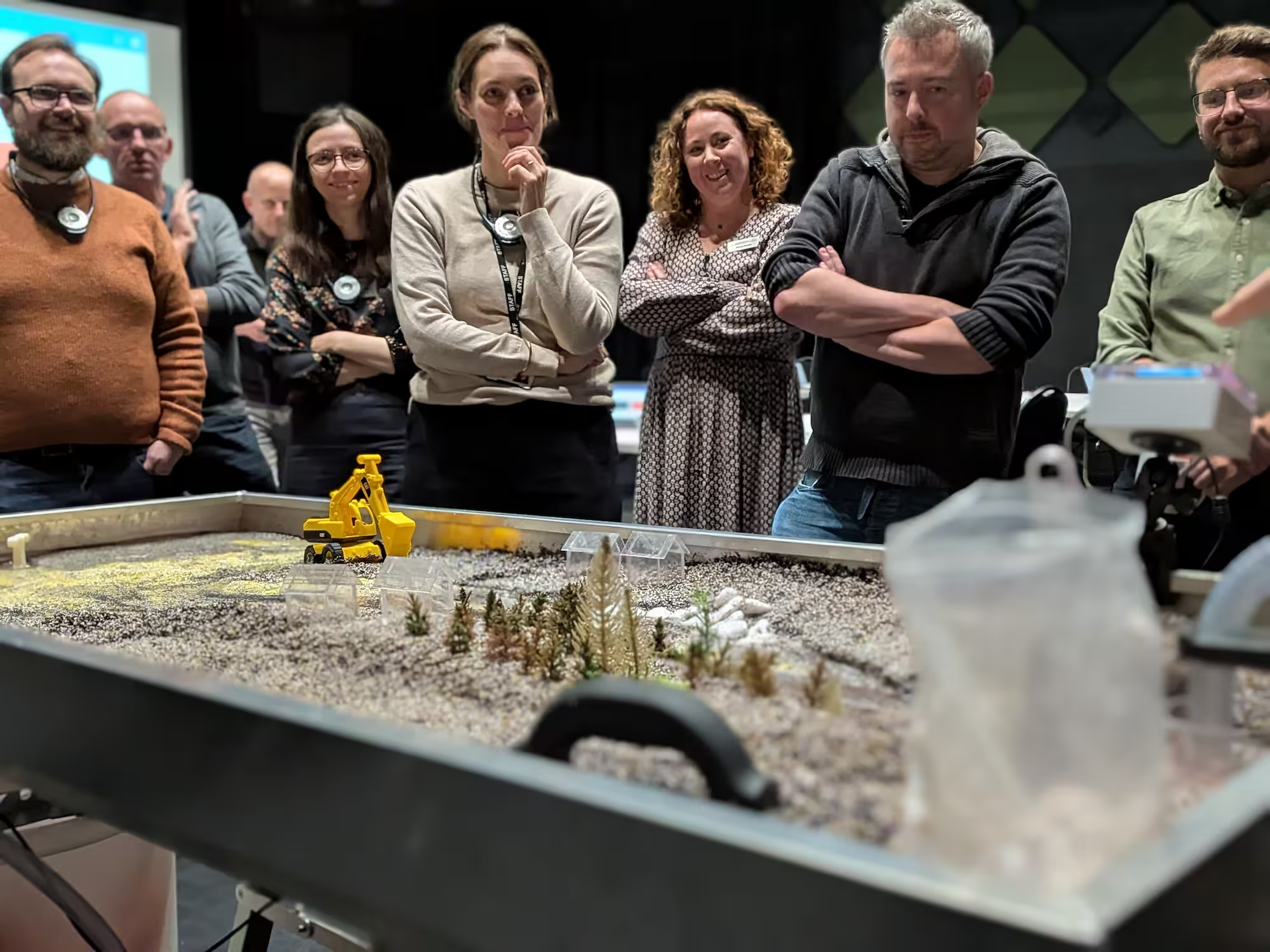
    Several people stand around a large table filled with a miniature landscape of soil, toy trees, houses, and a yellow construction vehicle. The individuals, dressed in casual clothing, look on with thoughtful or attentive expressions, some with their arms crossed, suggesting they are observing a demonstration or project.

    A political forum for the Taff Catchment

    Following the inaugural meeting of the Political Forum for the Taff Catchment Partnership on 22 October 2026, David Clubb considers why it’s a necessary piece of the governance jigsaw

    The inaugural meeting

    On 22 October, elected representatives from across the Taff catchment met for the first time as the Taff Catchment Political Forum, at YMa in Pontypridd. The location was no accident; Pontypridd’s experience of Storm Dennis in February 2020 is one of the reasons this partnership exists, and it’s a town where the question of what happens following the next weather warning is never far from the mind of local residents.

    Politicians are a key link between the public institutions that serve us, and we – the citizens. Elected members are accountable at regular intervals at the ballot box, and undertake vital roles of scrutiny, budget-setting, legislation and planning policy. They can advocate on behalf of constituents, especially helpful when dealing with large statutory bodies that occasionally get things wrong.

    The positive feedback from the Members and support staff who attended has helped validate this component of governance. The participants were asked what they wanted from the session, and the responses were broadly aligned around some key themes:

    • To find out what the Taff Catchment Partnership aims to do
    • Networking within a geographically focused remit, with good connections made with Natural Resources Wales (NRW)
    • To relay concerns from constituents about wider issues – flooding and wildfires
    • To better understand some of the key technical constraints and issues around flooding and wildfire to be able to better inform constituents

    This was a two-way conversation; yes, we have an offer to make to our political representatives, but we were very pleased to see their understanding of their own roles in helping to support our own objectives which mirror their concern – such as reducing the impact of flooding, improving biodiversity and involving communities more in the life of the river.

    What we heard

    NRW experts were asked to provide a summary of some of the key themes for the catchment, and gave a sense of the scale of the issue.

    Natural Resources Wales provided plenty of environmental and regulatory context for attendees

    For example, misconnected drains, which is where household foul water enters river courses or surface water drains directly, are not generally understood to be a major thing (at least to me!), but are in fact responsible for a significant amount of water quality problems in the catchment.

    On flooding, we were introduced to the metric of ‘Principality Stadiums’ in terms of volume of water that would need to be impounded in order to prevent flooding in Pontypridd – from memory, I think as much as 19 Principality Stadiums in volume might be needed, taking account of likely heavier climate-change induced rainfall. Engineered solutions of this scale simply cannot be implemented for a range of reasons, which is why I’m so interested in the ability of a reinvigorated ecosystem to play a much greater role in holding water in the soil.

    Fixing drains; slowing the flow in upland streams by using leaky wooden dams. These are not glamorous fixes; they are slow, patient responses – exactly what the Future Generations Act requires of us. And they will benefit us in more ways than simply pouring concrete (which we know can’t solve the whole situation anyway).

    We also saw a demonstration of a geomorphology table, which was a star attraction during the day. It provides a demonstration of the sorts of processes that can take place within river systems. So simply dredging somewhere does not necessarily resolve problems – in fact it can exacerbate them. However, it’s one thing to be told the facts, it’s quite another to see them playing out in real time. A strong recommend for our future events!

    We heard from participants that it’s hard to understand who is responsible for what, which is true; NRW, local authorities and Dŵr Cymru all have a role to play in water management, with Welsh Government setting policy direction. A complex administrative environment. Yet at times of heavy rainfall, residents experience water rising at their doorstep rather than administrative boundaries, another reason why story-telling and engagement are critical components of a catchment-based approach rather than add-ons to a technocratic approach.

    We also heard that residents want to be empowered to take action. Local flood groups are one practical way to ensure a better flow of information, and hopefully citizens who are more able to respond at times of heightened flood risk. Resilience in the true meaning of the word.

    During my time at the National Infrastructure Commission for Wales (NICW), we undertook a range of study tours that included talking to people about flooding, in Fairbourne, Crickhowell and Llanrwst. The consistent message was the feeling of dread that arises with weather warnings – this is a huge psychological burden that manifests in real health impacts. The challenge for anybody working in the flooding sector is to understand that our communications and practical work must be contextualised by those feelings. It’s a challenge I take very personally as Chair of the Taff Catchment Partnership. This issue emphasises the need for nuance and consideration when talking about the need for long-term activity in the uplands and headwaters, when much of the impact is felt in the valley floor and the floodplains.

    Participants also described how a range of wider stakeholders need to be involved – third sector organisations, local councillors and businesses. We very much hope that our governance structures will enable these voices to be heard in our work.

    Why a Political Forum *and* a Community Forum?

    Political representatives are elected to reflect and represent their constituents – so why have a Community Forum at all?

    The Community Forum is a space for people who live and work within the catchment to tell the Partnership directly what they are experiencing, with nobody translating on their behalf. These are the people who know which gully always blocks, where the water runs when it rains most heavily, and what it feels like to hear of the latest weather warning. Communities are not bound by political cycles – many people will remain within their local area for decades, and that brings its own local knowledge and wisdom.

    However, communities do not have access to budgets, or levers of power. They can advocate, organise, protest even – but they have no direct means of bringing about change.

    The Political Forum brings a mandate and power that can influence developments, and certainly narratives. Whilst the Senedd has more representatives within the catchment Members of the UK Parliament have the ability to influence UK-wide legislation and budget priorities. Both institutions bring considerable benefits to the Taff Catchment Partnership. The casework received by elected representatives enables them to feel the pulse from across the whole catchment, rather than just a street-by-street basis. So they can represent constituents, but no elected representative wishes to speak instead of communities.

    We will be mindful of when the Political Forum and the Community Forum align in their representations – and also when they don’t, and what this means in trade-offs or a question of values.

    In preparing for this role, I took a look at a publication called ‘Governance in Complexity‘, published by the European Environment Agency in 2024. That report distinguishes between whether a decision is technically right, and whether the process that reached it was open, accountable and fair. Confusing these two issues is a recurring cause of governance failure.

    By providing a clear space for political accountability, alongside a strong community voice, we ensure that neither will be absorbed into the technical and statutory machinery of the Board, and can remain true to their original rationale.

    How does the Forum fit into wider governance?

    The Political Forum is an advisory body. Decisions for the Taff Catchment Partnership stay within the Strategic Board and the organisations that hold statutory duties and budgets. The Political Forum will play a vital role in advocacy, scrutiny and visibility.

    The Chair and Deputy are elected by the membership, and must come from different political parties, ensuring that the operation is a cross-party one.

    As Independent Chair, I intend to be available as a key link between the Strategic Board and the Political Forum. However that’s up to the Forum itself, and that’s the point. The Political Forum will run itself and will define its own priorities.

    I’m a big fan of transparency in governance, and that’s why the current Terms of Reference (ToR) say that summary notes will be published (likely on this website), and that the ToR will be reviewed after each Senedd and UK general election.

    Next steps

    We anticipate that the Political Forum will meet again within the next few months, this time to carry out the business of agreeing the ToR, electing a Chair and Deputy, and starting to consider how the members want the Forum to operate.

    We should assume there will be some sort of flooding incident somewhere within the catchment this winter; the Partnership is here to help our elected representatives carry out their vital work in their constituencies with information and networks of support.

    The meeting closed with an aspiration of representatives from across the political spectrum coming along to learn, understand, lead and act. The Taff runs through a number of constituencies, and the political response needs to understand the complexity of all of it.


    All images and video courtesy of the author. The views expressed here are of David Clubb, Independent Chair of the Taff Catchment Partnership.

    Fediverse Reactions
  • Notes from the uplands

    Notes from the uplands

    Notes from the uplands

    David Clubb, Independent Chair of the Taff Catchment Partnership, gives his personal reflections from the Landscapes Wales seminar 2026

    Reflections from the sessions

    The Landscapes Wales seminar for 2026 was held in the uplands of the Taff catchment on 13 and 14 October, and as the new Chair of the Taff Catchment Partnership I was very grateful to receive an invitation courtesy of the organisers, Tirweddau Cymru.

    To tell you the truth, I felt a bit of an imposter as I signed up; clearly landscape management is fundamental to how the Taff catchment operates, and my experience doesn’t follow a traditional career path in this sector. However, when I turned up and saw many familiar faces, it reminded me that my many years working in onshore wind, as well as several projects I’ve delivered engaging local communities with National Landscape strategy development, qualify me in ways that are both unconventional and relevant. I came away with a lot to think about, but one thread kept coming back: how often good people work in spite of the systems they sit within, rather than because of them.

    The Taff catchment benefits from a diverse range of landscapes and landscape managers. These include private landowners, local authorities, Dŵr Cymru, the National Trust and the Bannau Brycheiniog National Park Authority. Several contributors work day to day within local communities outside designated landscapes, and their contribution kept discussions grounded in the impact ‘on the ground’, balancing the strategic with the operational while keeping in view the needs of people who ordinarily might not be regular visitors to the outdoors.

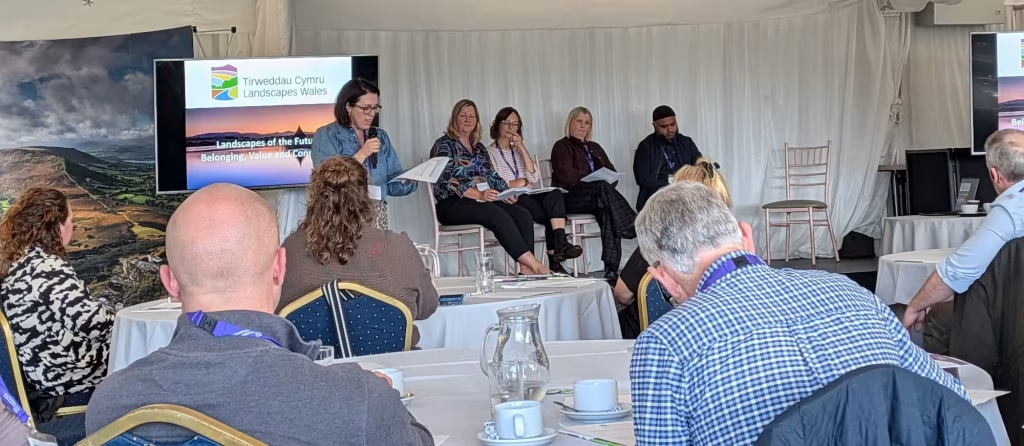
    Panel discussion about "Landscapes of the Future: Belonging, Value and Connection" with a speaker at a microphone and four seated panelists, with an audience in the foreground.

    The first afternoon kicked off with a plenary panel and discussion on the value of landscapes in contemporary Wales. I’m gonna say it – how refreshing to have a panel made up of such a diverse group. We heard from Rebecca Falvey (Cardiff National Park City), Lowri Jones (National Trust – focusing on engaging valleys communities), Ismail Kholwadia (Focal Elements) and Helen Nelson (Future Generations), ably chaired by Naomi Jones of Eryri National Park.

    Whilst all the speakers provided insight, I was particularly taken with Ismail’s challenge to designated landscape actors not to sit back and wait for people from diverse communities to just ‘discover’ the benefits of rurality and the outdoors. That challenge lands squarely on the Taff. Many of the communities at the heart of our catchment live outside its designated landscapes, and it’s the Partnership’s job to ensure that they are empowered to engage with us, not wait for them.

    On a personal level I was delighted to see Rebecca Falvey representing the Cardiff National Park City, as I led the campaign for four years until 2023, and I remain convinced not only of the need for this concept, but of the value in connecting our urban populations to the nature on our doorstep. Connecting people deeply with nature in towns and cities will surely improve outcomes and support for nature in rural areas as well.

    The second afternoon offered a choice of three sessions. My heart said the guide walk leader taster session, but given the summer we’ve just had, my head said the wildfire session. I always feel that, given two fantastic choices, there’s no such thing as a wrong one, but I did feel a tiny bit of regret on hearing the positive feedback from the guide walk!

    Nonetheless, the wildfire session was both brilliant and concerning. As I’ve argued here previously, wildfire and flood are two sides of the same coin, and it seems that, whilst we are insufficiently prepared for both, wildfire exposes us particularly cruelly. Although the valleys have long been a ‘hotspot’ for wildfires, often started deliberately (highlighting the importance of social causes), the devastation this summer was of a whole different order. Numerous issues were raised, including a lack of institutional prioritisation, a lack of sufficient equipment of the right type, and insufficient collaboration between the relevant organisations. A shout-out here to Becky Davies of Natural Resources Wales, the internal lead for the Taff Catchment Partnership, who spoke with considerable authority and passion on the topic. She is a showcase for the collaboration we’ll need if we are to build resilience to increasing cycles of destruction in the coming years and decades, through upland fire and lowland flood.

    The day finished with a preview screening of a film entitled “who gives a **** about polar bears” by the BAFTA award-winning producer Gavin Porter. Honestly, I was blown away. It’s at least as much homage to Butetown as a documentary about climate change, and I can’t wait for the finished article. I think it would sit beautifully within a programme of local climate change engagement (such as this!), and we’re at the stage in the climate crisis where we probably need a Gavin in every town and city across Wales, investigating and interpreting grassroots reactions to the growing impact of climate change on our everyday lives.

    A short clip of Gavin’s climate crisis documentary, as shared on LinkedIn

    The second day focused on the social impact of designated landscapes, and on governance. Research presented by the University of Warwick suggested that people living in and near designated landscapes value that designation. But as Prof. Calvin Jones pointed out, we don’t know whether people in equally beautiful but undesignated parts of Wales – much of Powys, Ceredigion, Carmarthenshire, the upland valleys – would say much the same. Without that comparison, I struggle to see a direct link between designation itself and social benefit for residents.

    Howard Davies brought that session to an end with a discussion about governance. He introduced it as a ‘dry’ topic, but for me nothing could be further from the truth! Governance sits at the heart of decision-making in Wales, and improving it is probably one of the quickest ways to improve outcomes across a whole swathe of organisations delivering a myriad of services to Wales’ citizens. With the Taff Catchment Partnership designing its own governance right now, the session couldn’t have been more timely. Anyway, the discussion was lively, and I think it bodes extremely well for designated landscapes that this sort of internal scrutiny is happening. Governance must be continuously challenged and refreshed if it’s to remain relevant and valuable.

    As a general theme (and not just from this session!), I’m often struck by how often people operate in spite of, rather than supported by, their various bureaucracies. My day job is at a university, so I’m no stranger to finding routes within systems. As somebody who’s worked in organisations both large and micro, the trade-off for me is very clear: large institutions bring large resources and potentially huge impact, but the acknowledged silos within them are inherent barriers to information flow and activity.

    The Future Generations Act mandates five Ways of Working on public bodies in Wales and, I’d argue, they’re good practice for any organisation. Yet I see far too few examples of these Ways of Working done well, particularly integration and collaboration. It’s not the fault of individuals, but of the systems that govern the modern workplace. KPIs and annual appraisals almost always relate to things you have the budget to deliver. So a change that saves a local authority money but pushes demand onto the NHS can count as a win on one balance sheet and a cost on another, and nobody’s appraisal captures both.

    In the Taff, this could take the form of pooled resources between the three local authorities, Dŵr Cymru and Bannau Brycheiniog, delivering more ambitious and wide-ranging habitat restoration than any single body working alone. Some of this may already be happening; if so, I’d love to hear about it, and the Partnership should be the place where we do more of it.

    So here’s my suggestion. We need a more enlightened view of line management, risk management and corporate governance – one that embeds 10% of staff time in integration and collaboration, even where the direct benefit to the organisation isn’t immediately obvious. Or perhaps it becomes something assessed each year for every member of staff. Something for audit and risk committees to chew on in the coming years, perhaps.

    Man in floral shirt takes a selfie with a "no cycling" sign and a valley town in the background under a partly cloudy sky.

    As I cycled down to Abercynon train station, a journey completed in about a tenth of the time of the route up (and not taking the ‘no cycling’ track!), I took with me plenty of new connections and insights, and a renewed sense of the passion and dedication of everybody working in this sector. Despite differences in experience and opinion, this is a sector that truly wants the best for the people of Wales. My thanks to the organisers for an excellent event. I look forward to building on the relationships started there.


    Cover video courtesy of the author. The views expressed here are of David Clubb, Independent Chair of the Taff Catchment Partnership.