
A political forum for the Taff Catchment
Following the inaugural meeting of the Political Forum for the Taff Catchment Partnership on 22 October 2026, David Clubb considers why it’s a necessary piece of the governance jigsaw
The inaugural meeting
On 22 October, elected representatives from across the Taff catchment met for the first time as the Taff Catchment Political Forum, at YMa in Pontypridd. The location was no accident; Pontypridd’s experience of Storm Dennis in February 2020 is one of the reasons this partnership exists, and it’s a town where the question of what happens following the next weather warning is never far from the mind of local residents.
Politicians are a key link between the public institutions that serve us, and we – the citizens. Elected members are accountable at regular intervals at the ballot box, and undertake vital roles of scrutiny, budget-setting, legislation and planning policy. They can advocate on behalf of constituents, especially helpful when dealing with large statutory bodies that occasionally get things wrong.
The positive feedback from the Members and support staff who attended has helped validate this component of governance. The participants were asked what they wanted from the session, and the responses were broadly aligned around some key themes:
- To find out what the Taff Catchment Partnership aims to do
- Networking within a geographically focused remit, with good connections made with Natural Resources Wales (NRW)
- To relay concerns from constituents about wider issues – flooding and wildfires
- To better understand some of the key technical constraints and issues around flooding and wildfire to be able to better inform constituents
This was a two-way conversation; yes, we have an offer to make to our political representatives, but we were very pleased to see their understanding of their own roles in helping to support our own objectives which mirror their concern – such as reducing the impact of flooding, improving biodiversity and involving communities more in the life of the river.
What we heard
NRW experts were asked to provide a summary of some of the key themes for the catchment, and gave a sense of the scale of the issue.

For example, misconnected drains, which is where household foul water enters river courses or surface water drains directly, are not generally understood to be a major thing (at least to me!), but are in fact responsible for a significant amount of water quality problems in the catchment.
On flooding, we were introduced to the metric of ‘Principality Stadiums’ in terms of volume of water that would need to be impounded in order to prevent flooding in Pontypridd – from memory, I think as much as 19 Principality Stadiums in volume might be needed, taking account of likely heavier climate-change induced rainfall. Engineered solutions of this scale simply cannot be implemented for a range of reasons, which is why I’m so interested in the ability of a reinvigorated ecosystem to play a much greater role in holding water in the soil.
Fixing drains; slowing the flow in upland streams by using leaky wooden dams. These are not glamorous fixes; they are slow, patient responses – exactly what the Future Generations Act requires of us. And they will benefit us in more ways than simply pouring concrete (which we know can’t solve the whole situation anyway).
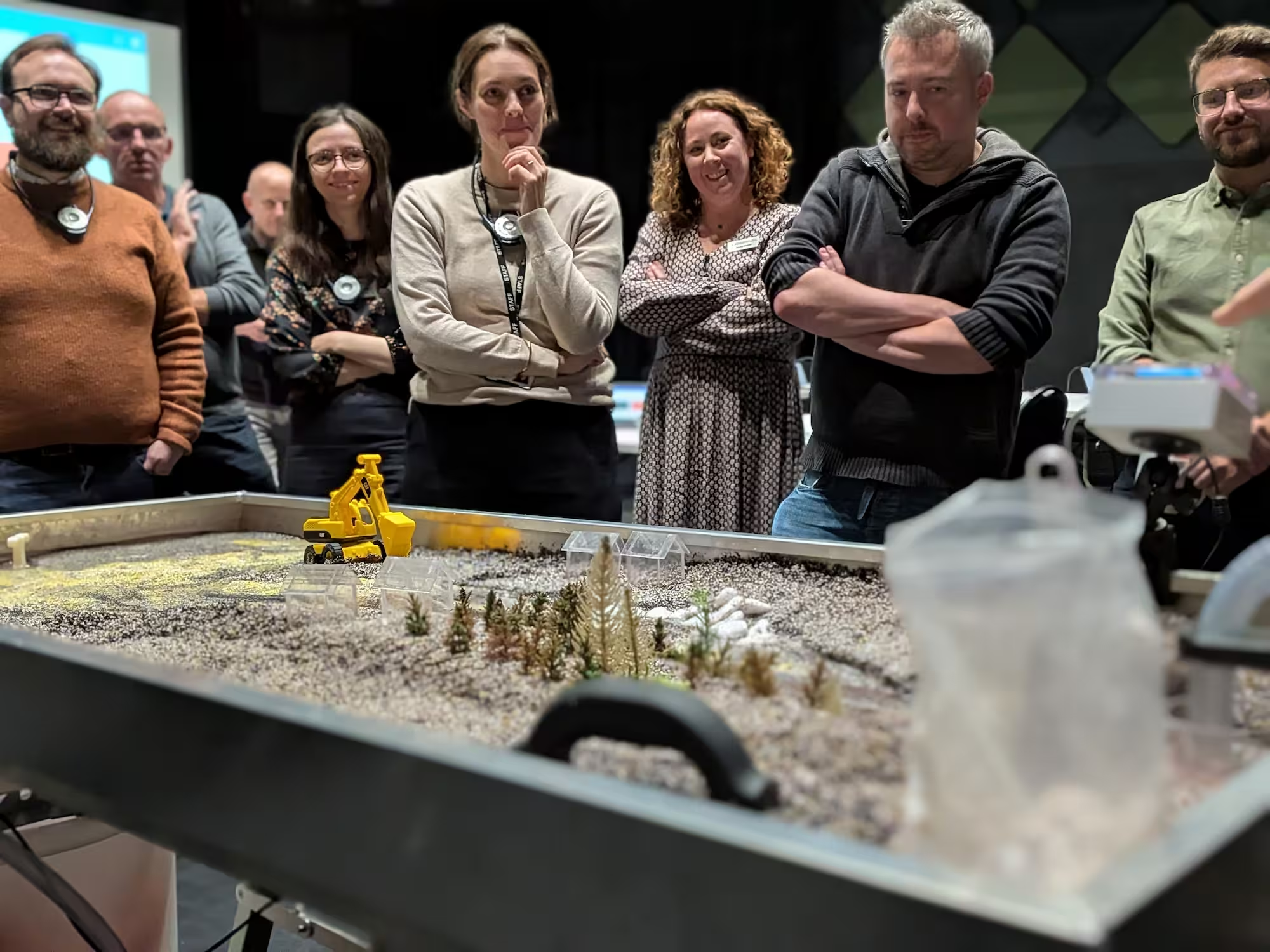
We also saw a demonstration of a geomorphology table, which was a star attraction during the day. It provides a demonstration of the sorts of processes that can take place within river systems. So simply dredging somewhere does not necessarily resolve problems – in fact it can exacerbate them. However, it’s one thing to be told the facts, it’s quite another to see them playing out in real time. A strong recommend for our future events!
We heard from participants that it’s hard to understand who is responsible for what, which is true; NRW, local authorities and Dŵr Cymru all have a role to play in water management, with Welsh Government setting policy direction. A complex administrative environment. Yet at times of heavy rainfall, residents experience water rising at their doorstep rather than administrative boundaries, another reason why story-telling and engagement are critical components of a catchment-based approach rather than add-ons to a technocratic approach.
We also heard that residents want to be empowered to take action. Local flood groups are one practical way to ensure a better flow of information, and hopefully citizens who are more able to respond at times of heightened flood risk. Resilience in the true meaning of the word.
During my time at the National Infrastructure Commission for Wales (NICW), we undertook a range of study tours that included talking to people about flooding, in Fairbourne, Crickhowell and Llanrwst. The consistent message was the feeling of dread that arises with weather warnings – this is a huge psychological burden that manifests in real health impacts. The challenge for anybody working in the flooding sector is to understand that our communications and practical work must be contextualised by those feelings. It’s a challenge I take very personally as Chair of the Taff Catchment Partnership. This issue emphasises the need for nuance and consideration when talking about the need for long-term activity in the uplands and headwaters, when much of the impact is felt in the valley floor and the floodplains.
Participants also described how a range of wider stakeholders need to be involved – third sector organisations, local councillors and businesses. We very much hope that our governance structures will enable these voices to be heard in our work.
Why a Political Forum *and* a Community Forum?
Political representatives are elected to reflect and represent their constituents – so why have a Community Forum at all?
The Community Forum is a space for people who live and work within the catchment to tell the Partnership directly what they are experiencing, with nobody translating on their behalf. These are the people who know which gully always blocks, where the water runs when it rains most heavily, and what it feels like to hear of the latest weather warning. Communities are not bound by political cycles – many people will remain within their local area for decades, and that brings its own local knowledge and wisdom.
However, communities do not have access to budgets, or levers of power. They can advocate, organise, protest even – but they have no direct means of bringing about change.
The Political Forum brings a mandate and power that can influence developments, and certainly narratives. Whilst the Senedd has more representatives within the catchment Members of the UK Parliament have the ability to influence UK-wide legislation and budget priorities. Both institutions bring considerable benefits to the Taff Catchment Partnership. The casework received by elected representatives enables them to feel the pulse from across the whole catchment, rather than just a street-by-street basis. So they can represent constituents, but no elected representative wishes to speak instead of communities.
We will be mindful of when the Political Forum and the Community Forum align in their representations – and also when they don’t, and what this means in trade-offs or a question of values.
In preparing for this role, I took a look at a publication called ‘Governance in Complexity‘, published by the European Environment Agency in 2024. That report distinguishes between whether a decision is technically right, and whether the process that reached it was open, accountable and fair. Confusing these two issues is a recurring cause of governance failure.
By providing a clear space for political accountability, alongside a strong community voice, we ensure that neither will be absorbed into the technical and statutory machinery of the Board, and can remain true to their original rationale.
How does the Forum fit into wider governance?
The Political Forum is an advisory body. Decisions for the Taff Catchment Partnership stay within the Strategic Board and the organisations that hold statutory duties and budgets. The Political Forum will play a vital role in advocacy, scrutiny and visibility.
The Chair and Deputy are elected by the membership, and must come from different political parties, ensuring that the operation is a cross-party one.
As Independent Chair, I intend to be available as a key link between the Strategic Board and the Political Forum. However that’s up to the Forum itself, and that’s the point. The Political Forum will run itself and will define its own priorities.
I’m a big fan of transparency in governance, and that’s why the current Terms of Reference (ToR) say that summary notes will be published (likely on this website), and that the ToR will be reviewed after each Senedd and UK general election.
Next steps
We anticipate that the Political Forum will meet again within the next few months, this time to carry out the business of agreeing the ToR, electing a Chair and Deputy, and starting to consider how the members want the Forum to operate.
We should assume there will be some sort of flooding incident somewhere within the catchment this winter; the Partnership is here to help our elected representatives carry out their vital work in their constituencies with information and networks of support.
The meeting closed with an aspiration of representatives from across the political spectrum coming along to learn, understand, lead and act. The Taff runs through a number of constituencies, and the political response needs to understand the complexity of all of it.
All images and video courtesy of the author. The views expressed here are of David Clubb, Independent Chair of the Taff Catchment Partnership.
