
What is a catchment partnership?
This is a guest post by David Clubb, Independent Chair of the Taff Catchment Partnership.
A revolution in governance?
As a physicist who has efficiency as part of their professional DNA, I’m dedicated to learning from others and adopting good practice in Wales as fast as possible. We have huge structural, demographic and climate change challenges, and we shouldn’t expect evolutionary good practice to alleviate our social, economic and environmental issues.
I previously Chaired the National Infrastructure Commission for Wales (NICW) which undertook a significant study into how to mitigate the impacts of flooding in Wales in the long term. The report is called “Building resilience to flooding in Wales” and one of the recommendations was for Welsh Government to:
“by 2026, pilot and set up regional/local Catchment Partnerships”.
There are numerous other references to catchment approaches in the report, such as another recommendation to ” streamline Flood & Coastal Erosion Risk Management plans into catchment resilience strategies”, and the recognition that “flood risk governance…governance is further hindered by a fragmented approach to regional and catchment working”
What should a Catchment Partnership do?
Of course, it’s very early days yet for the Taf(f) Catchment Partnership (TCP), but here are some headline suggestions from that NICW report:
- Bring together broad disciplines, through catchment teams, supported by inclusive public representation including large landowners, businesses and (housing) developers, to coordinate integrated catchment responses across the water environment.
- Help establish positive collaboration with landowners and the farming community.
- Support small-scale pilots to test and refine methods whilst also piloting a catchment approach akin to the Knepp Estate for the Bannau Brycheiniog Mega Catchment (BBMC). Use the pilots to exemplify the benefits of a different model for individuals, business, organisations, to build large-scale long-term resilience.
- Use Citizens Juries, including a Youth Jury, to convene local groups to influence decisions about climate change adaptation for their community.
The above is aspirational and it’s entirely possible that the TCP won’t be able to meet all of them, but we will certainly be aiming high, and as you can see from the initial ‘ways of working’ schematic, we have attempted to bring in a wide range of relevant groups and stakeholders, with much of the membership of these groups yet to be confirmed.
Building bridges across Wales and beyond
There are currently several catchment partnerships in south Wales, including our two closest neighbours in the south east, the Usk Catchment Partnership (UCP); and the Wye Catchment Partnership (WCP) which also encompasses large areas of Herefordshire.
We will be learning plenty from our fellow Catchment Partnerships; the WCP has been operating since 2014, and the UCP since 2023. However in general Wales is behind England in this good practice approach, which has adopted a ‘Catchment Based Approach’ (CaBA) across all 100+ catchments.

CaBA describes itself as ‘an inclusive, civil society-led initiative working in partnership with government, local authorities, water companies, businesses and more, to maximise the natural value of the environment’ The framework was piloted by Defra in 2012 and rolled out nationally the following year, so it now has well over a decade of institutional experience behind it.
One figure on the CaBA stands out: CaBA partnerships have, on average, leveraged more than eight times their initial core investment from other funding sources. This is a track record built on the credibility that comes from bringing so many sectors around one table, and from the catchment plans, underpinned by robust evidence, that each partnership develops.
Just as we’re making the case for catchment partnerships to be given a proper footing here in Wales, CaBA has recently made much the same argument in England. In its response to the Independent Water Commission (the Cunliffe Review), CaBA called for a stronger mandate and greater funding for catchment partnerships, setting out the role they could play in any future governance model for land and water management. So even though we’re playing catch-up, it’s clear that our friends in England can see further improvements to a well-established, England-wide movement. This suggests that we could potentially use our late starter status as an opportunity to learn from – and sidestep – some of the inevitable mistakes that will have been made from the pioneers in this approach.
The TCP is very much still finding its feet but we’re not starting from nothing. There’s a decade of institutional memory on the Wye, a fresh co-design approach on the Usk, and over ten years of evidence from CaBA on what actually works at catchment scale. If we can borrow the best of all three, the Taff Catchment Partnership might just have a head start on the revolution in governance we need.
Exciting times are ahead!
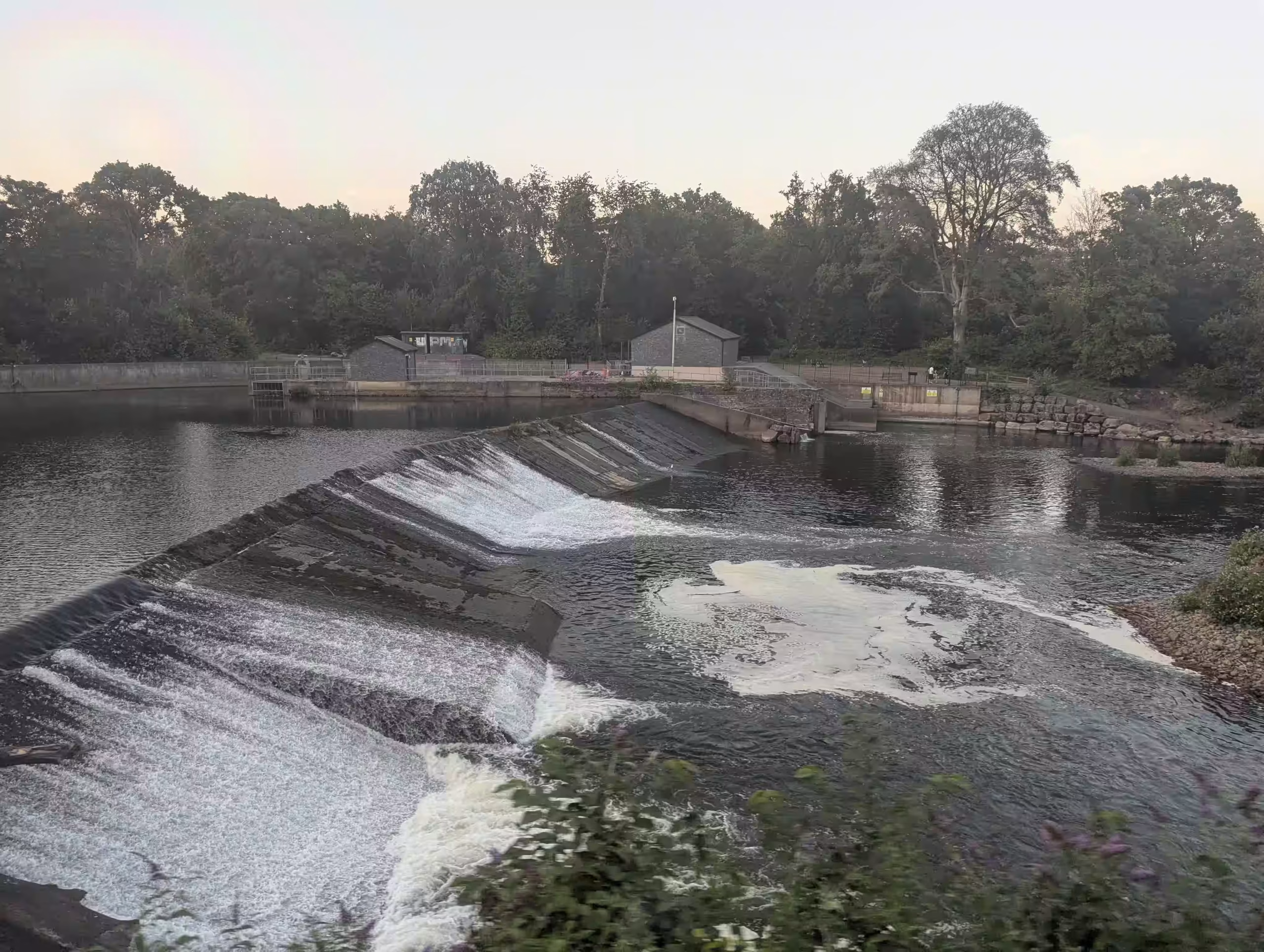
Cover image courtesy of David Clubb. The views expressed here are of David Clubb, Independent Chair of the Taff Catchment Partnership.